
The star effect in gemstones
The star effect in gemstones is an extraordinary optical phenomenon in which a bright, star-shaped pattern appears to float across a gemstone’s surface, moving as the stone or light source changes position.
This optical phenomenon is known as asterism, or the star effect. It is best known in sapphire and ruby, although it can also occur in several other gemstones under the right conditions.
The star is not a marking painted on the surface or a pattern created by cutting. It results from light reflecting from numerous microscopic features arranged in particular directions inside the gemstone. When these reflections intersect, they create the rays of the star.
What is the star effect?
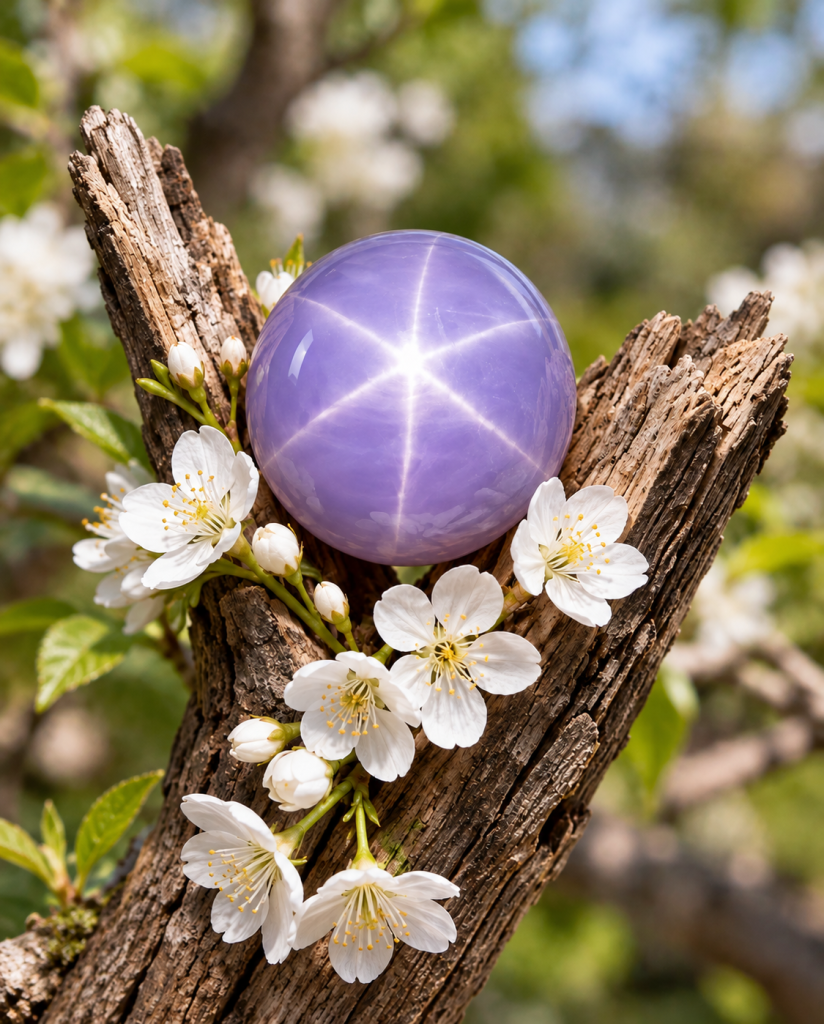
Asterism is an optical phenomenon in which intersecting bands of reflected light form a star across the surface of a gemstone.
The effect is generally seen in stones cut as cabochons, which have a smooth, rounded surface rather than flat facets.
As the gemstone is tilted beneath a concentrated light source, the star appears to move across the surface. Depending on the gemstone and its internal structure, the star may have four, six, twelve, or occasionally another arrangement of rays.
Six-rayed stars are particularly familiar in star sapphire and star ruby.
How can you visually identify asterism?
The easiest way to identify the star effect is to examine a cabochon-cut gemstone under a single, concentrated light source.
Hold the stone face-up and slowly move either the gemstone or the light. Look for several narrow bands of reflected light crossing one another to form a recognizable star.
A genuine asterism effect should behave dynamically. As the stone is tilted, the star should appear to glide across its curved surface rather than remaining fixed in one position.
Look for these main visual characteristics:
- two or more intersecting bands of reflected light
- a recognizable star positioned across the cabochon
- rays that become clearer under a concentrated light source
- movement of the star when the gemstone or light source moves
- rays that may become weak or almost disappear under broad, diffused lighting
Direct sunlight or a small bright lamp can make asterism easier to observe.
The moving nature of the star is also useful for distinguishing asterism from fixed internal patterns such as the trapiche effect. A trapiche pattern remains physically positioned within the gemstone, while an asterism star follows changes in illumination.
What causes asterism?
Asterism usually occurs when a gemstone contains numerous microscopic inclusions or internal structures aligned along particular crystallographic directions.
In ruby and sapphire, the effect is commonly associated with fine needle-like inclusions, often involving rutile and traditionally described as silk.
When light reaches these oriented features, it is reflected in concentrated bands. Multiple sets of inclusions positioned in different directions create multiple bands, and where those bands intersect, a star becomes visible.
The exact inclusions responsible for asterism vary between gemstone species, so the microscopic cause of a star in sapphire is not necessarily identical to that in garnet or diopside.
Why are star gemstones usually cut as cabochons?
The cabochon cut plays an essential role in displaying asterism.
Its smooth, domed surface allows reflected light from the internal inclusions to become concentrated into visible rays.
Orientation is equally important. Before cutting, the lapidary must determine how the star-producing inclusions are positioned within the rough material. The stone is then oriented so that the star appears correctly across the finished cabochon.
Poor orientation can produce an off-center, incomplete or weak star, even when the gemstone contains suitable inclusions.
How many rays can a star gemstone have?
The number of rays depends on the arrangement of the internal structures responsible for the phenomenon.
Six-rayed stars are especially familiar in ruby and sapphire, where three reflected bands intersect.
Some gemstones can display four-rayed stars, while unusual specimens may show twelve rays when more than one set of star-producing inclusions contributes to the effect.
The number of rays is therefore related to the gemstone’s internal structure and crystallography rather than being created artificially by the shape of the cabochon.
Which gemstones can display the star effect?
Asterism has been documented in several gemstone materials. Important examples include:
- sapphire
- ruby
- emerald — exceptionally rare
- alexandrite — very rare
- garnet, including some specific garnet varieties
- diopside — uncommon
The phenomenon is particularly well known in sapphire and ruby. In the other gemstones listed above, asterism is considerably less commonly encountered and may have a different appearance.
Not every specimen of these gemstones can produce a star. The stone must contain the appropriate oriented internal features and normally needs to be cut correctly to reveal them.
Star sapphire
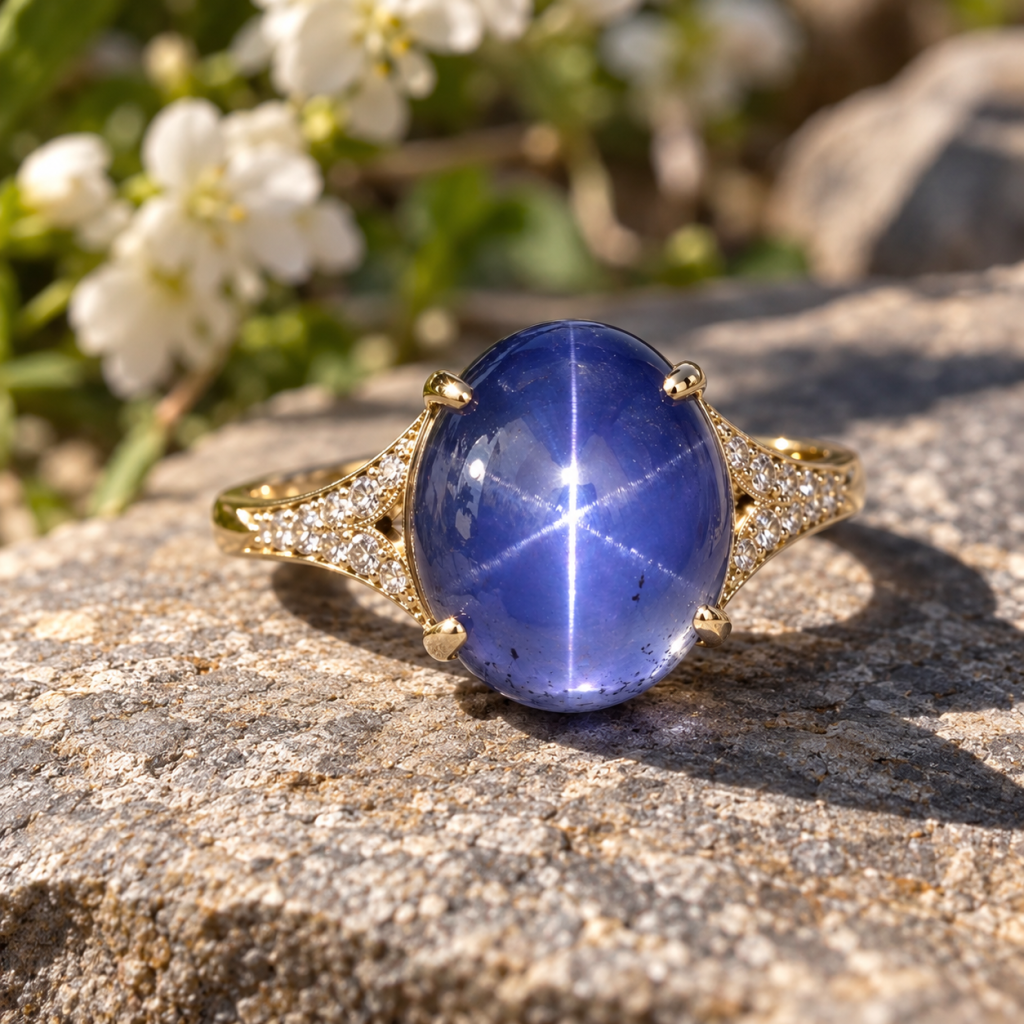
Sapphire is one of the gemstones most strongly associated with asterism.
Star sapphires commonly display six rays produced when light reflects from oriented microscopic inclusions within the corundum crystal.
Although blue star sapphires are particularly familiar, the phenomenon can occur in sapphires of other colors.
In a well-displayed example, the rays are clearly recognizable, meet close to the center of the cabochon and move smoothly across the surface as the stone is tilted.
Some sapphires can also display twelve-rayed stars when different sets of oriented inclusions contribute to the effect.
Star ruby
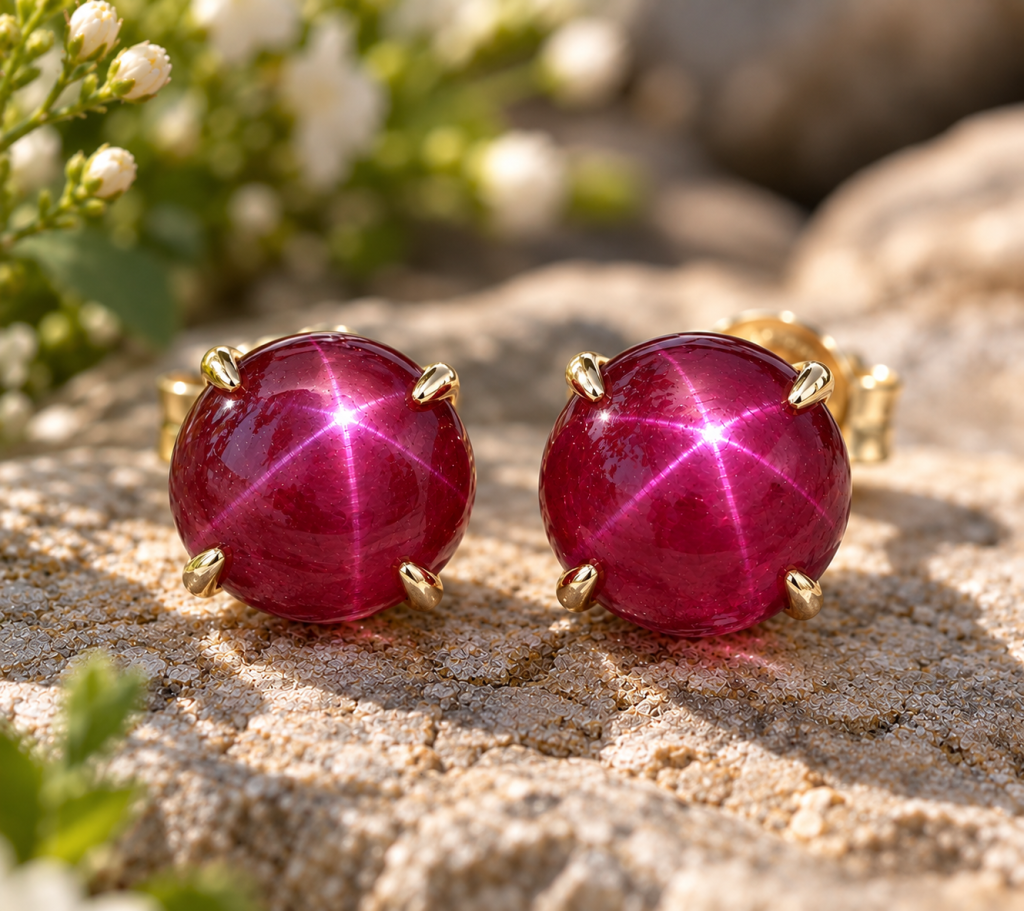
Ruby is the red variety of corundum and can display asterism through a mechanism similar to that found in star sapphire.
A star ruby typically displays six rays crossing its red to purplish-red body color.
Under a concentrated light source, the star can become much more distinct. As the ruby is moved, the intersection of the rays appears to travel across the cabochon’s surface.
The inclusions responsible for the star can also influence transparency. For this reason, a fine star ruby represents a balance between attractive body color, sufficient inclusions to create the phenomenon, and an appealing overall appearance.
Star emerald
Asterism in emerald is exceptionally rare.
Emerald belongs to the beryl family and has a different crystal structure and inclusion environment from corundum. In unusual material, however, suitably oriented internal features can create intersecting reflected bands and a star-like effect.
Care is required when identifying asterism in emerald because emeralds commonly contain fractures and complex inclusions that can produce various reflections. Random crossing reflections should not automatically be classified as a true star effect.
Genuine asterism in emerald is therefore an unusual gemological occurrence.
Star alexandrite
Alexandrite is best known for color change, but very rare examples can also display asterism.
Alexandrite belongs to the chrysoberyl family. When suitably oriented internal features are present and the stone is correctly cut, they can produce intersecting bands of reflected light.
Asterism should not be confused with chatoyancy, another phenomenon found in chrysoberyl. Chatoyancy produces a single eye-like band, while asterism produces intersecting rays forming a star.
An alexandrite displaying both unusual optical behavior and color change can be particularly interesting from a gemological perspective.
Star garnet
Asterism occurs in some members of the garnet group, although it is considerably less common than in ruby or sapphire.
Star garnets may display four or six rays depending on the internal structures and their orientation.
Because garnet represents a group of related minerals rather than a single gemstone variety, the exact appearance and cause of the star can differ between specimens.
A concentrated light source is usually needed to observe the star clearly, particularly when the garnet has a darker body color.
Star diopside
Diopside can also display asterism.
Star diopside is usually cut as a cabochon and is particularly known for examples displaying a four-rayed star.
The arrangement and angles of the rays differ from the familiar six-rayed appearance of many star sapphires and rubies because diopside has a different crystal structure.
The phenomenon is uncommon and depends on the presence and correct orientation of suitable internal inclusions.
What makes a good star?
The visual quality of asterism can vary considerably from one gemstone to another.
A well-displayed star generally has clearly recognizable rays that intersect attractively on the surface of the cabochon. The star should also move smoothly when the gemstone is tilted beneath a concentrated light.
The body color of the gemstone remains important. A strong star does not automatically compensate for unattractive color, poor cutting or other undesirable characteristics.
The symmetry and proportions of the cabochon can also influence how centered and distinct the star appears.
Why does lighting matter?
Asterism is strongly dependent on lighting.
A single concentrated light source, such as direct sunlight or a small bright lamp, generally produces the clearest star because the oriented inclusions reflect the light in distinct bands.
Under broad or diffused illumination, the rays may become much weaker and can sometimes appear to disappear.
For this reason, a star gemstone should ideally be viewed in motion and under different lighting conditions rather than judged from a single photograph.
Does a star prove that the gemstone is natural?
No. The presence of a star does not prove that a gemstone is natural.
Synthetic gemstones can also display asterism. Synthetic star rubies and star sapphires, for example, have been produced for many years.
This means that identifying a star effect and determining whether a gemstone is natural are two separate questions.
Gemologists examine features such as inclusions, growth structures and other physical or chemical characteristics to distinguish natural stones from synthetic materials. Laboratory testing may be necessary when the origin of a significant gemstone needs to be established confidently.
Asterism confirms the presence of an optical phenomenon, not the natural origin of the gemstone.
Does the star effect increase value?
A strong and attractive star can contribute to the rarity, beauty and collector interest of a gemstone, but asterism alone does not determine value.
The overall evaluation also depends on factors such as body color, transparency, size, cut, treatment status, natural or synthetic origin, the sharpness and position of the star, and the overall quality of the gemstone.
For star stones specifically, the appearance of the phenomenon is important. A distinct, centered and smoothly moving star may be more desirable than one that is weak, broken or poorly positioned.
The special effect should therefore be considered as one part of the gemstone’s overall quality rather than an independent guarantee of high value.
When microscopic features create a visible star
The most fascinating part of asterism is that a large, visible star can originate from microscopic structures hidden inside a gemstone.
When countless fine inclusions are arranged in the right directions, a properly oriented cabochon allows their reflections to work together. Under concentrated light, those tiny internal features become visible as intersecting rays moving across the surface.
Sapphire and ruby provide the best-known examples, while rare occurrences in emerald, alexandrite, garnet and diopside demonstrate how the phenomenon can appear in different mineral environments.
Asterism is therefore more than a decorative star. It is a visible interaction between crystal structure, internal inclusions, cutting and light, making it one of the most recognizable and fascinating special effects found in gemstones.