
Emerald Pricing Guide
Our Emerald Pricing Guide helps you understand how emerald values are determined in today’s gemstone market. This Emerald Pricing Guide explains the key factors influencing price, including color quality, clarity characteristics, origin, cut, and overall rarity. By following this Emerald Pricing Guide, buyers can confidently compare emeralds and make informed decisions when selecting a gemstone that balances beauty, quality, and value.
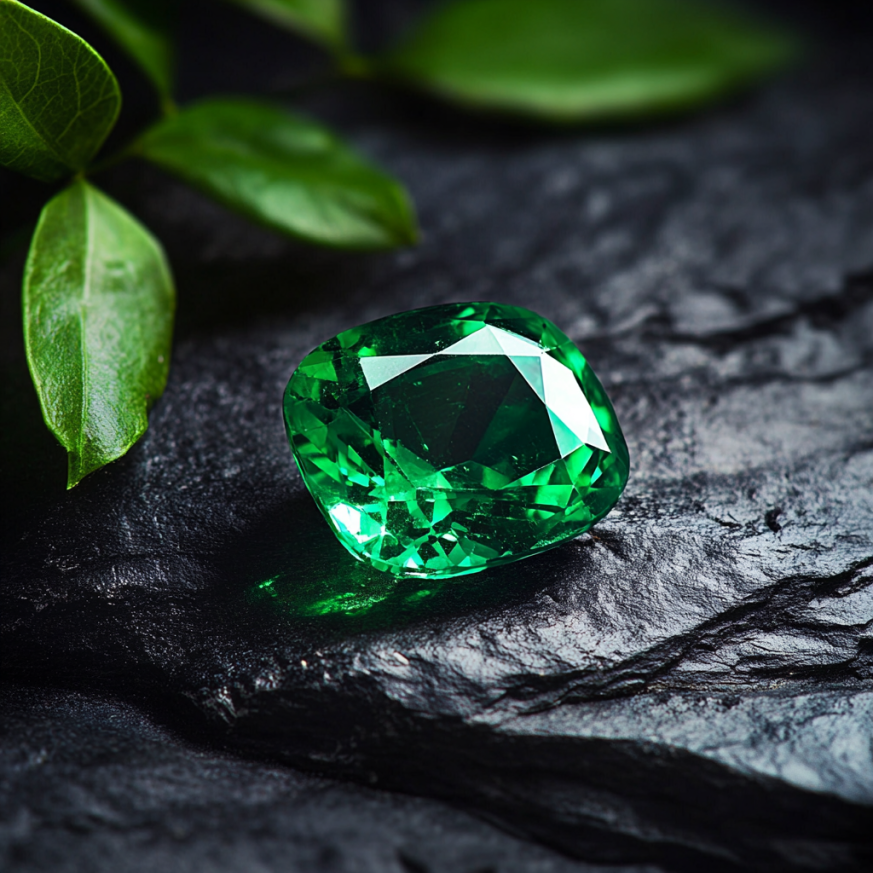
Why Clarity & Color Saturation Matter More Than Size
Unlike other gemstones (like rubies), emerald pricing is not primarily driven by carat weight.
Large emerald crystals are commonly recovered from mines around the world. What is rare and therefore valuable is:
- Vivid, pure green color
- Strong saturation
- Good transparency
- Minimal treatment
A 4-carat emerald with moderate saturation and heavy inclusions may be worth less per carat than a 1-carat emerald with vivid color and strong transparency.
Emerald value is fundamentally a quality-driven market, not a size-driven one.
The Primary Drivers of Emerald Pricing
1. Color (Dominant Factor)
Color is the single most important determinant of value.
The most valuable emeralds display:
- Rich, vivid green
- Strong saturation
- Balanced medium tone
- Minimal yellow or gray modifier
Even slight gray or yellow undertones can significantly reduce pricing.
Strong, evenly distributed color throughout the stone commands a substantial premium.
2. Transparency & Clarity
Emeralds are Type III gemstones inclusions are expected.
However, pricing depends on how inclusions affect transparency, not simply their presence.
Light inclusions/clarity
Natural internal features that do not interrupt transparency. Acceptable and expected.
Moderate inclusions/clarity
Visible inclusions that slightly reduce brilliance. Moderately impacts value.
Heavy inclusions / Fracturing
Reduces transparency and durability. Strongly lowers pricing.
High-transparency emeralds with minimal disruption to light return are extremely rare and command substantial premiums, especially when paired with strong saturation.
3. Treatment Level (Oiling)
Most emeralds are treated with oil or resin to reduce the visibility of fissures.
Minor Oil
Industry standard and widely accepted. Maintains strong value.
Moderate Oil
Noticeable reduction in price versus minor oil equivalents.
Significant Oil or Resin Filling
Substantial price reduction due to durability and long-term stability concerns.
No / Insignificant Oil
Very rare in fine-quality emeralds and commands strong premiums, especially when color and transparency are also strong.
Where Carat Weight Fits
Carat weight increases price per carat but only when quality is already strong.
Size alone does not create value in emeralds.
General Carat Behavior
- Under 1 carat → price mostly driven by color and clarity
- 1–3 carats → price increases if quality remains strong
- 3+ carats → premium only if saturation and transparency are preserved
- 5+ carats → collector tier only when clarity and color are exceptional
Large emeralds with mediocre color or heavy oil do not experience exponential pricing like ruby.
In emerald, quality must scale with size for price to escalate meaningfully.
Current Retail Market Pricing by Quality (All Sizes)
(Approximate per-carat retail ranges; treatment dependent)
| Quality Tier | Description | Typical Price per Carat |
| Commercial Green | Noticeable yellow/gray, heavy inclusions | $300 – $1,500 |
| Medium Green | Pleasant color, moderate transparency | $1,500 – $6,000 |
| Rich Green | Strong saturation, good transparency | $5,000 – $20,000 |
| Fine Vivid Green | Intense color, strong transparency, minor oil | $15,000 – $60,000 |
| Exceptional | Vivid color, excellent transparency, minimal oil | $50,000 – $150,000+ |
Exceptionally large stones with top color and minimal oil may exceed these ranges.
How Color & Clarity Interact
In emerald pricing:
- Strong color + poor transparency = discounted
- Excellent clarity + weak color = discounted
- Strong color + strong transparency = exponential premium
E6782| play | middle| “5.12 Ct. Emerald from Colombia”
E8273| play | middle| “10.94 Ct. Emerald from Colombia”
E6374| play | middle| “2.68 Ct. Emerald from Colombia”
The rarest emeralds combine:
- Deep, vivid green
- Even color distribution
- Strong light return
- Minimal oil
- Manageable clarity
It’s the overall combination of factors, not size alone, that determines top-tier pricing.
Emerald Pricing Summary
Emerald pricing is primarily driven by:
- Color saturation and tone
- Transparency and clarity
- Treatment level
- Market demand
E2590| play | middle| “9.21 Ct. Emerald from Zambia”
Carat weight increases price only when quality remains strong.
Unlike ruby, large emeralds are not inherently rare. What is rare is finding large emeralds with vivid color, strong transparency, and minimal oil.
Recognizing this difference allows buyers to focus on the true value of emeralds, including beauty, durability, and rarity of quality, instead of size alone.
Discover more exceptional pieces by exploring our stunning emerald collection HERE.