
- Pair13
- Reports4


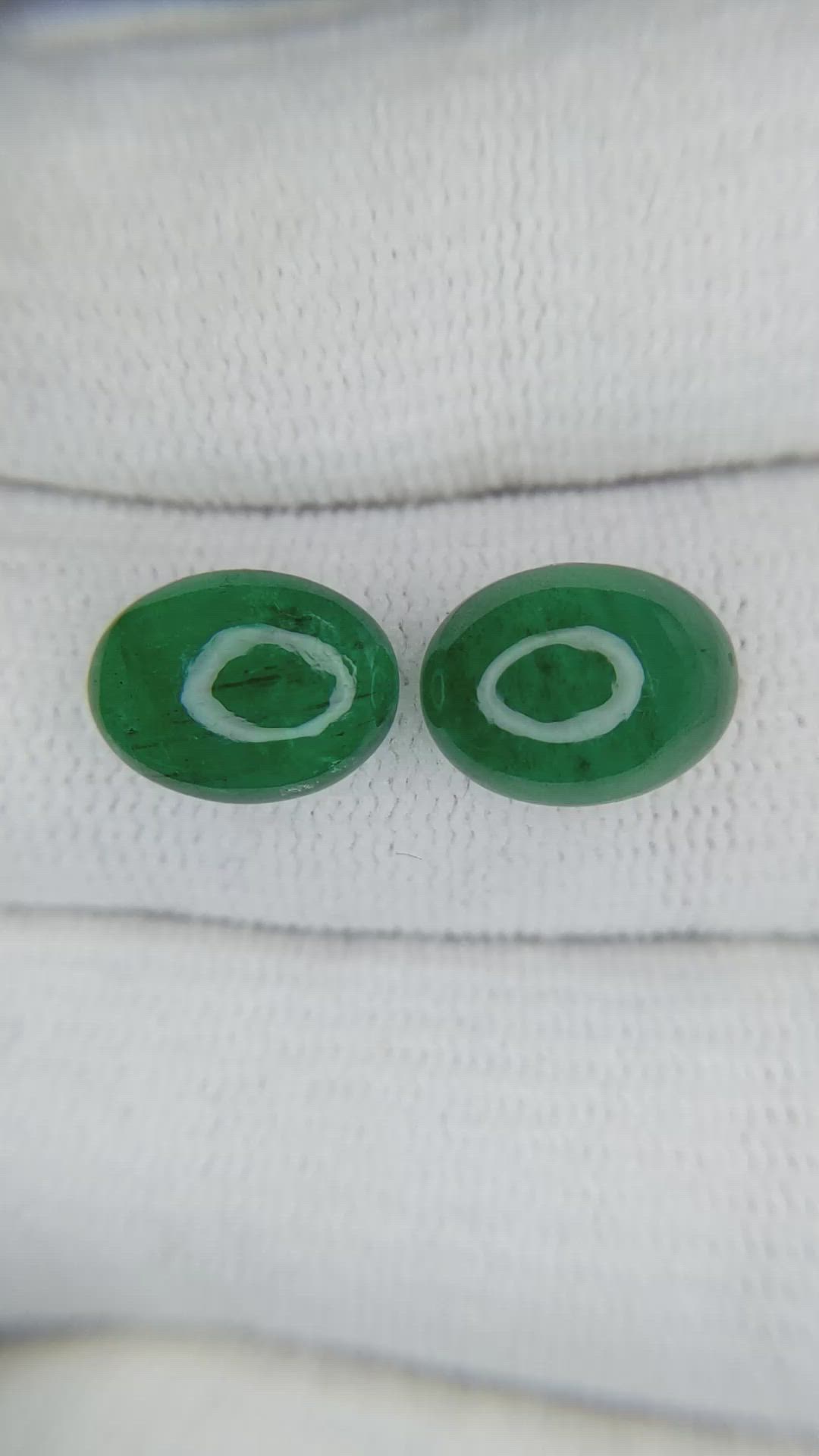





6.83 Ct.Tw.Total Carat Weight Cabochon Emerald Pair from Zambia
This pair of stones ships by Nov 7
Stone type: | Emerald | Emerald |
|---|---|---|
Item ID: | PR13615 | PR13615 |
Dimensions (MM): help | Length: 10.93 Width: 8.23 Height: 4.65 | Length: 11.06 Width: 8.48 Height: 5.64 |
Weight: | 3.00 Ct. | 3.83 Ct. |
Color: help | Green | Green |
Color intensity: help | Dark | Dark |
Clarity: help | Included | Included |
Shape: help | Oval | Oval |
Cut: | Cabochon | Cabochon |
Cutting style: | Cabochon | Cabochon |
Enhancements: help | Standard | Standard |
Origin: help | Zambia | Zambia |
Per carat price: help | $135 | $135 |
This pair of Zambian emeralds offered by The Natural Emerald Company presents a technical harmony between material quality and lapidary execution, each stone demonstrating clear provenance and measurable parameters. The stones weigh 3.00 carats and 3.83 carats respectively, and are fashioned into oval shaped cabochons, with dimensions of 10.93 by 8.23 by 4.65 mm for the smaller example, and 11.06 by 8.48 by 5.64 mm for the larger. Both exhibit translucent body color with a dark color intensity that concentrates green saturation toward the core of the domed table, and both have been graded internally as included at eye level, reflecting visible internal features under normal viewing conditions. The polish quality is excellent across both pieces, producing clean, well defined highlights on the domes and consistent light return across the circumference. Enhancement is disclosed as standard, a conventional and accepted practice for emeralds, and the material is identified as Zambian in origin, a source noted for deep forest green tones and strong chroma. These technical specifications are provided in full by The Natural Emerald Company to support informed evaluation by gemological buyers and designers.
The choice of a cabochon cut for these oval emeralds is purposeful and technically driven, prioritizing color saturation and visual depth over faceted brilliance. The lapidary approach emphasizes controlled dome curvature, balanced symmetry, and optimized thickness to manage light transmission and color zoning. Dome heights of 4.65 mm and 5.64 mm are substantial for stones of this footprint, creating a pronounced convex surface that minimizes light leakage and enhances apparent saturation, particularly effective for stones with internal features. The cutting workflow includes initial preforming to center the color plane, progressive fine grinding to establish an even profile, and final lapping and polishing using diamond abrasives followed by cerium oxide or similar agents to achieve the excellent polish observed. Edge rounding and girdle consistency are maintained to ensure secure bezel settings and to prevent stress concentrations that can exacerbate natural fissures. Color matching between the pair was achieved by selecting rough material with comparable absorption spectra and by orienting the same internal color planes during cutting, resulting in a visually cohesive set despite the 0.83 carat weight variance.
Clarity and enhancement are discussed in terms of their measurable impact on appearance and durability, and in terms that resonate with technical evaluators. The clarity grade included at eye level indicates the presence of internal features that are detectable without magnification under typical viewing, a common condition in natural emeralds and particularly consistent with Zambian crystallography. Standard enhancement refers to index matching treatments such as natural oils or proprietary low viscosity resins used to reduce the visual effect of surface reaching fissures and to improve apparent clarity, while preserving the stone stability for standard jewelry wear. These treatments are applied in controlled laboratory or workshop conditions, followed by inspection under 10 times magnification and by spectroscopy when necessary, to document the treatment fill and to confirm the optical effects. The cabochon geometry serves a practical role in mitigating the visual prominence of inclusions by diffusing light and enhancing perceived color, a technique employed by experienced cutters to maximize aesthetic return from material with inherent inclusions. Buyers will appreciate that every stage of evaluation for these stones has been conducted with standard gemological protocols, including microscopic examination and immersion viewing to assess the homogeneity of fill and the nature of internal features.
Ethical sourcing and supply chain integrity are central to the acquisition strategy for these Zambian emeralds, and The Natural Emerald Company adheres to explicit practices that support transparent provenance. Sourcing is conducted through documented channels that trace material back to named Zambian districts, leveraging verified relationships with artisanal and industrial producers who operate under national regulatory frameworks. The company requires mine level documentation and transport chain records, and participates in third party verifications and periodic audits to ensure no links to conflict financing or illicit trading. Field level commitments include support for traceability systems, engagement with local cooperatives to ensure equitable compensation, and investment in community projects that address access to water, education, and occupational safety. Environmental considerations are integrated into sourcing agreements, with an emphasis on minimizing landscape disturbance and promoting reclamation where feasible, and on selecting cutting and finishing partners who employ responsible waste management and recycle consumables. For the technical buyer seeking not only material quality but also ethical assurance, The Natural Emerald Company provides provenance documentation on request, detailed treatment disclosure, and the option for bespoke due diligence to meet institutional or private standards. These combined technical, gemological, and ethical factors position this matched pair as a considered choice for designers and collectors who value measurable attributes and traceable supply chain practices.


