
- Stone8
- Reports3
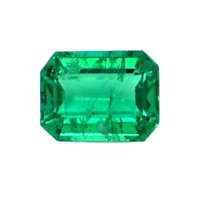

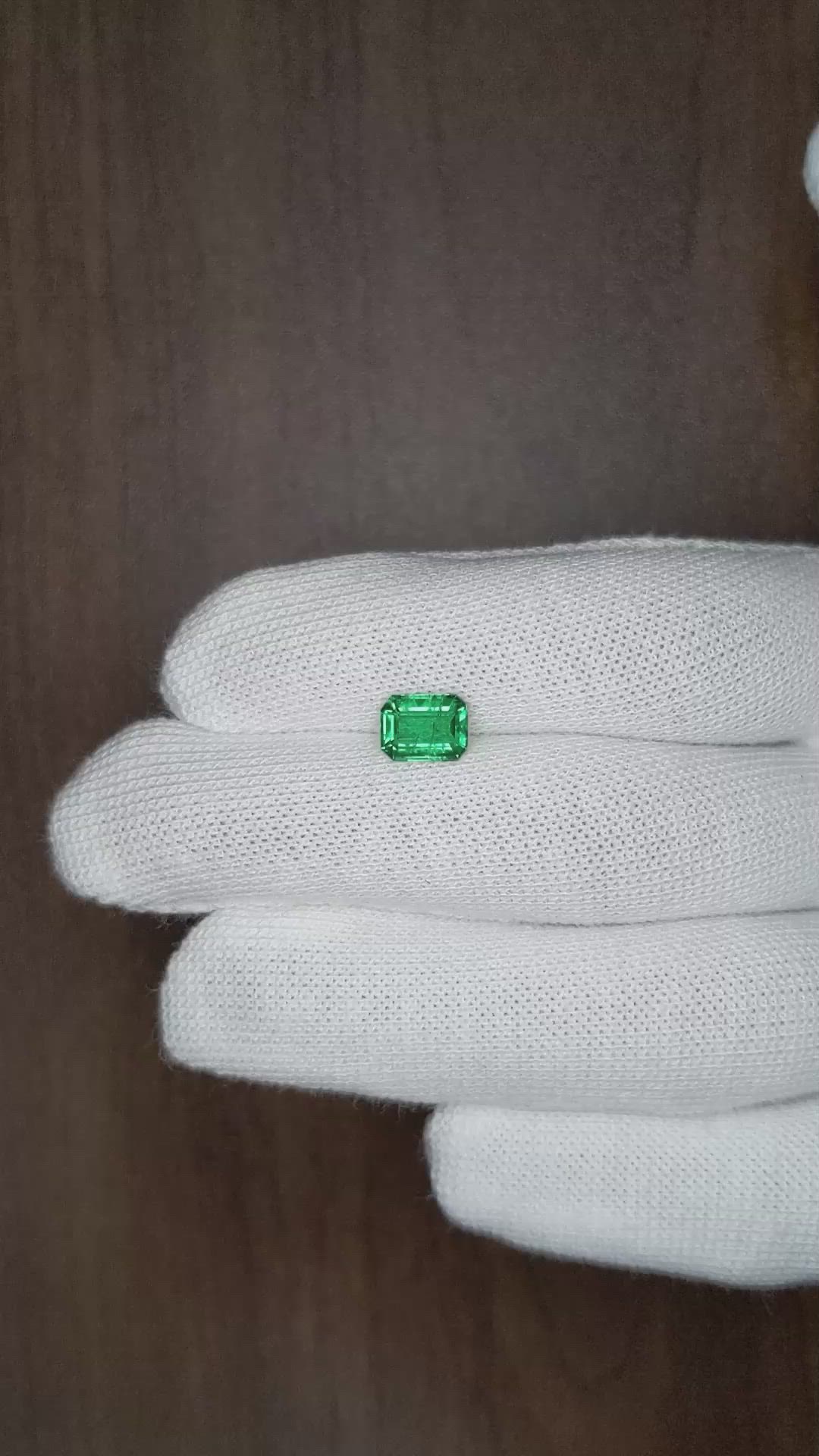

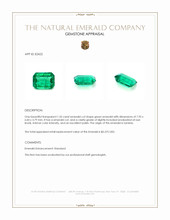


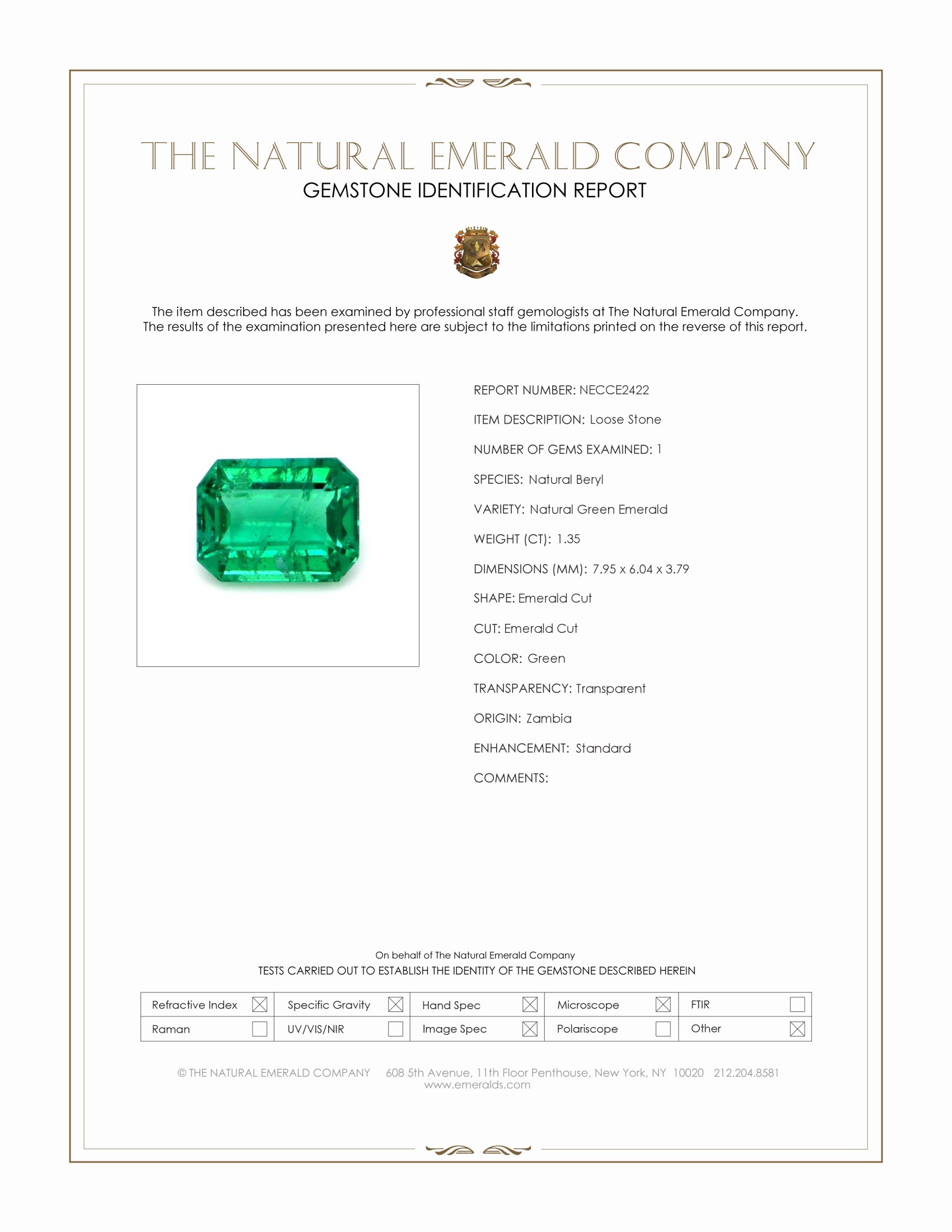
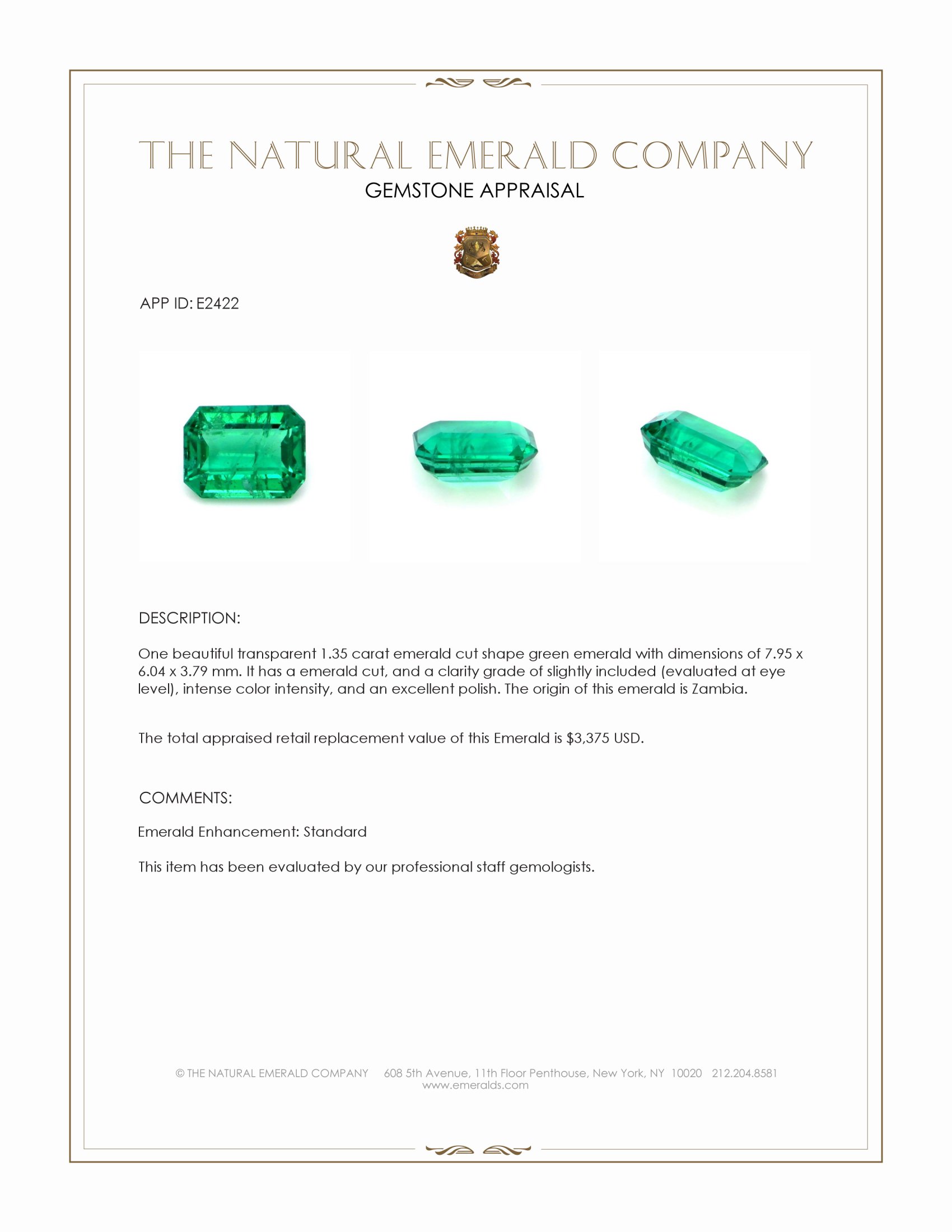
1.35 Ct. Emerald from Zambia
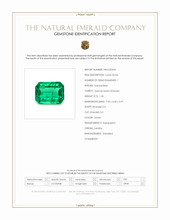
Item ID: | E2422 |
|---|---|
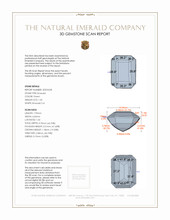
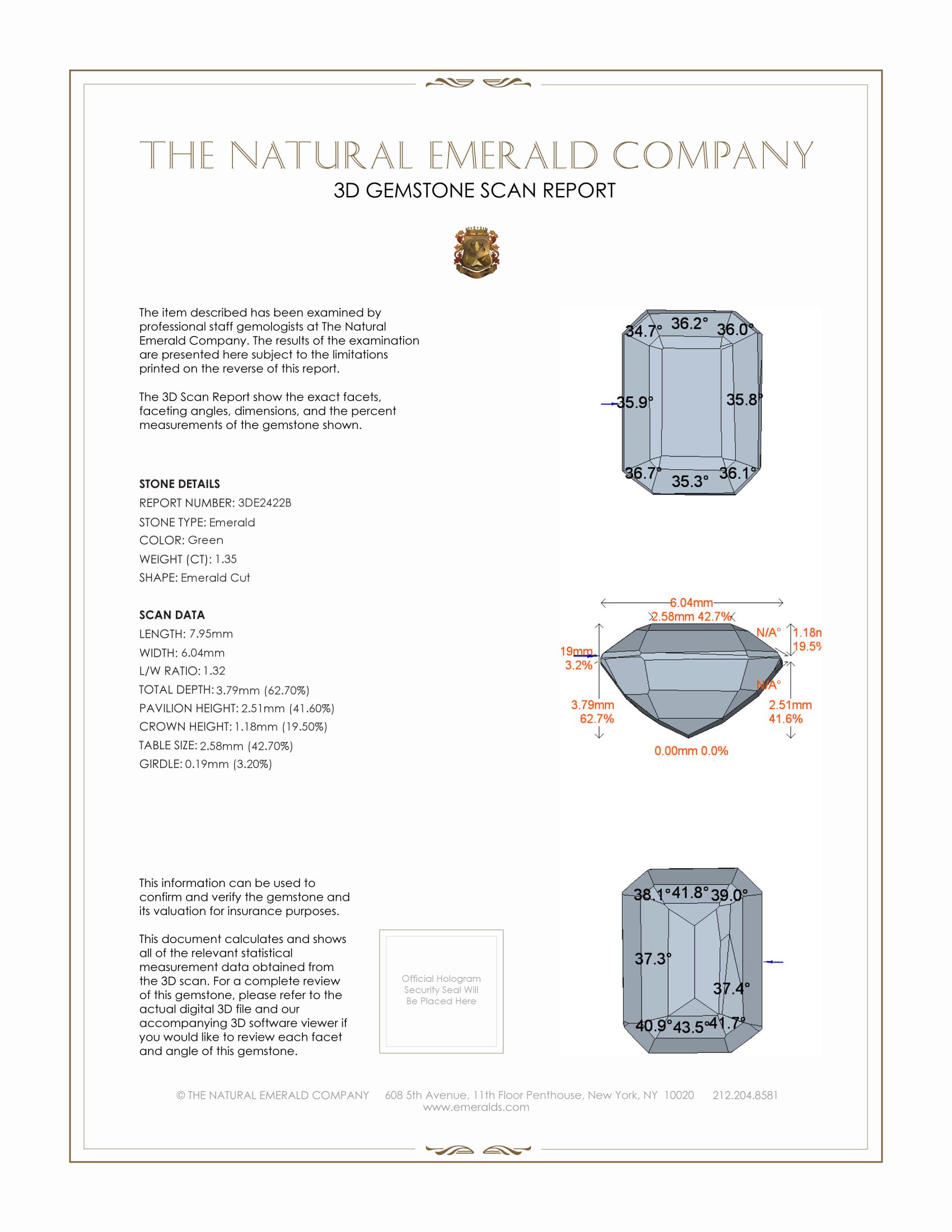
Dimensions (MM): help | Length: 7.95 Width: 6.04 Height: 3.79 |
Weight: | 1.35 Ct. |
Color: help | Green |
Color intensity: help | Intense |
Clarity: help | Slightly Included |
Shape: help | Emerald Cut |
Cut: | Emerald Cut |
Cutting style: | Faceted |
Enhancements: help | Standard |
Origin: help | Zambia |
Per carat price: help | $2,500 |
This transparent green emerald presents as a precise, faceted emerald cut weighing 1.35 carats, with dimensions 7.95 by 6.04 by 3.79 millimeters. The cutter has oriented the pavilion and crown to produce classical step facet geometry, creating broad parallel facets that emphasize color planes and a hall of mirrors effect rather than faceted brilliance alone. The length to width ratio of approximately 1.32 yields an elegant rectangular outline which is well suited to both solitaire and three stone settings. The measured depth for this piece corresponds to approximately fifty four percent of the average diameter, a proportion that balances face up area with sufficient pavilion volume to saturate color and preserve light return. The table facet is calibrated to work with the step system to present an even, stable face up color, while the truncated corners characteristic of the emerald cut reduce chipping risk at the girdle. Clarity is graded as slightly included at eye level, an indication that internal jardin is present but restrained, and the polish is excellent, with crisp facet junctions and a smooth crown that contribute to strong facet contrast and minimal surface diffusion of light.
Color intensity is recorded as intense, and the hue sits in the bluish green to pure green spectrum typical of fine Zambian material. Zambian chemistry often includes appreciable chromium and vanadium content which produces deeper, cooler green tones with a subtle blue bias, and this specimen displays that characteristic in a medium to medium dark tone with saturated chroma. The step cut accentuates these color planes, so color distribution is uniform across the table with no obvious zoning when viewed face up. Optical performance combines the broad flash geometry of step faceting with the stone being transparent enough to allow internal light travel, resulting in depth and depth related luster rather than scintillation. The slightly included clarity grade allows for internal features that are typical for emeralds, such as fine jardin and wisps, which can act as internal fingerprints of origin and formation, while the excellent polish ensures that surface reflections are clean and not softened by abrasions.
Enhancement conforms to standard industry practice, and this piece has been treated to conventional clarity enhancement to improve apparent transparency and stability. Standard enhancement for emeralds is intended to be stable under normal wear, but as with all emeralds some risk exists with exposure to aggressive solvents or ultrasonic cleaners, and professional handling is recommended when a cleaning regime is required. From a gemological standpoint the balance achieved here is noteworthy. The cutter retained weight while optimizing table size and facet proportions to accentuate color saturation without creating an overly dark window. The result is a gemstone that, despite being 1.35 carats, communicates the presence and authority of stones of larger carat weight because the cut concentrates chromatic saturation and controls light return. On the Mohs scale this material sits around seven and a half to eight, and the emerald cut with truncated corners provides a practical balance of elegance and durability for everyday jewelry use when properly set and cared for.
When comparing historical and famous emeralds, it is useful to consider both scale and optical personality, and to place this Zambian emerald within that context. The Chalk Emerald and the Duke of Devonshire Emerald are famous for their large size and historical provenance, with the Chalk Emerald noted for intense color and high transparency after recutting and repolishing, and the Duke of Devonshire notable as a colossal natural crystal. The Gachala and Moghul pieces are historically significant for size and cultural context, often exhibiting natural carvings or heavy inclusions. By contrast, this 1.35 carat emerald is not a museum scale specimen, but it occupies a different value niche. Its unique value derives from the combination of intense Zambian color chemistry, restrained inclusions that contribute character without overpowering transparency, and a high quality emerald cut that optimizes face up color and wearable dimensions. Historically prized stones can be heavily included or recut to save weight, but this specimen demonstrates that exceptional aesthetic and practical value can be achieved at a modest, wearable size through skilled lapidary work and careful material selection. In that sense this gem resembles in spirit the smaller, high quality gems used historically as personal jewels by connoisseurs, rather than the monumental museum pieces.
The Natural Emerald Company presents this emerald as an exemplar of modern lapidary craft applied to classic material, with provenance traced to Zambia and enhancement disclosed in accordance with industry best practices. For the client who appreciates technical details, the precise length to width ratio, the measured depth proportion, the step facet schema, the trade off between weight retention and color saturation, and the documented clarity grade will be useful metrics when selecting a setting and insurance value. Recommended settings that complement the emerald cut geometry include low profile east west or north south solitaires that protect the corners, or halo designs where micro pavé accent stones can enhance perceived size without compromising the stone geometry. We advise against high heat or ultrasonic cleaning and recommend a gentle warm water and mild detergent rinse with careful drying, and periodic professional inspection to assess the condition of any enhancement. For bespoke commissions, certification and detailed light table imagery are available on request, and our team at The Natural Emerald Company can provide comparative material and setting mock ups to ensure the finished piece meets both technical and aesthetic expectations.


