
- Stone11
- Reports3
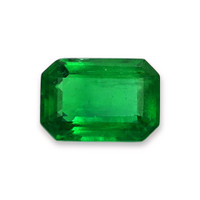
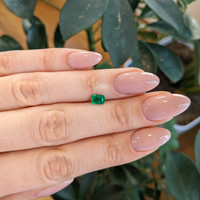
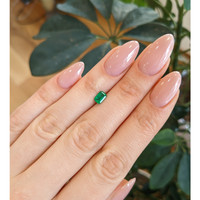
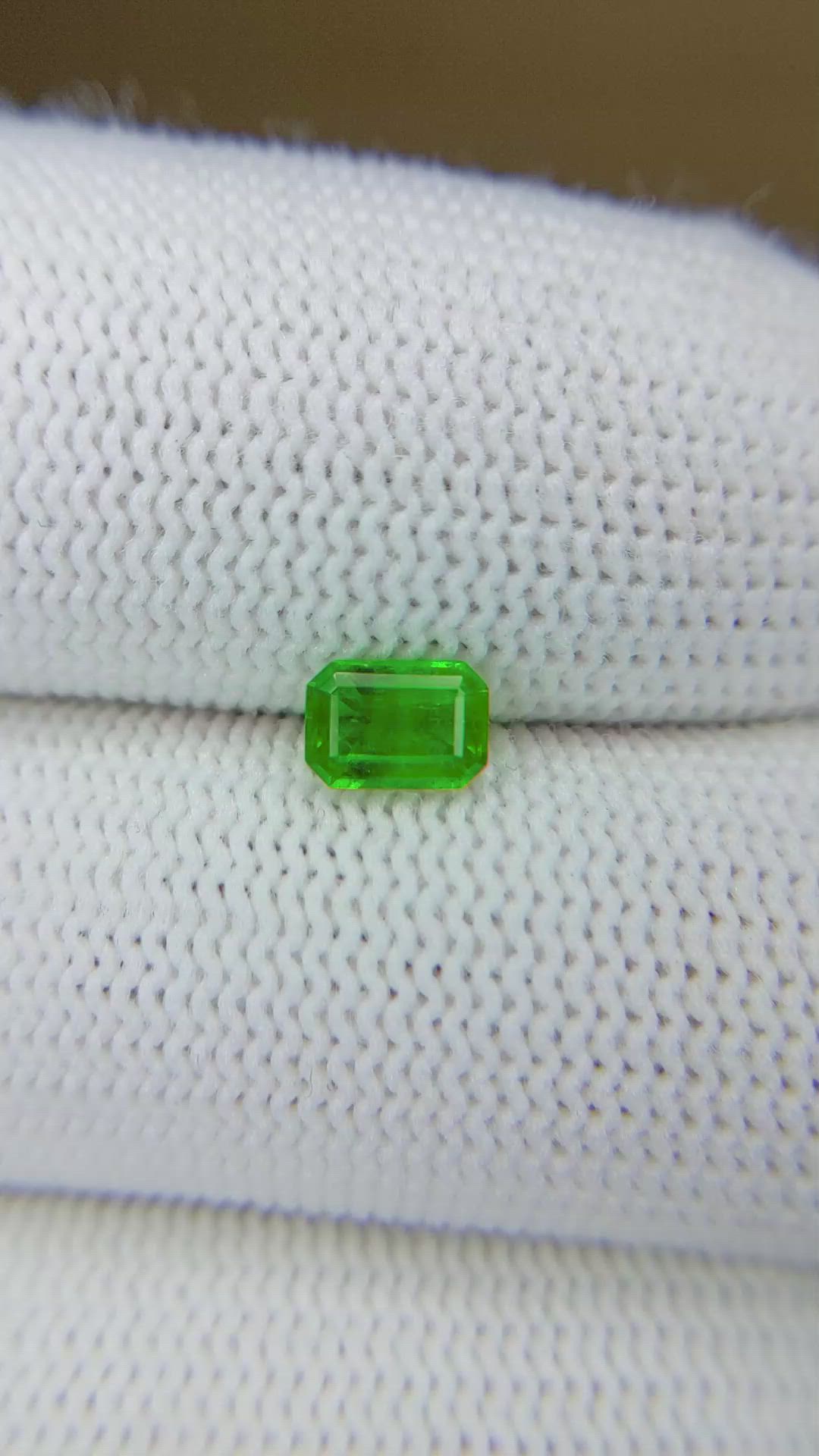
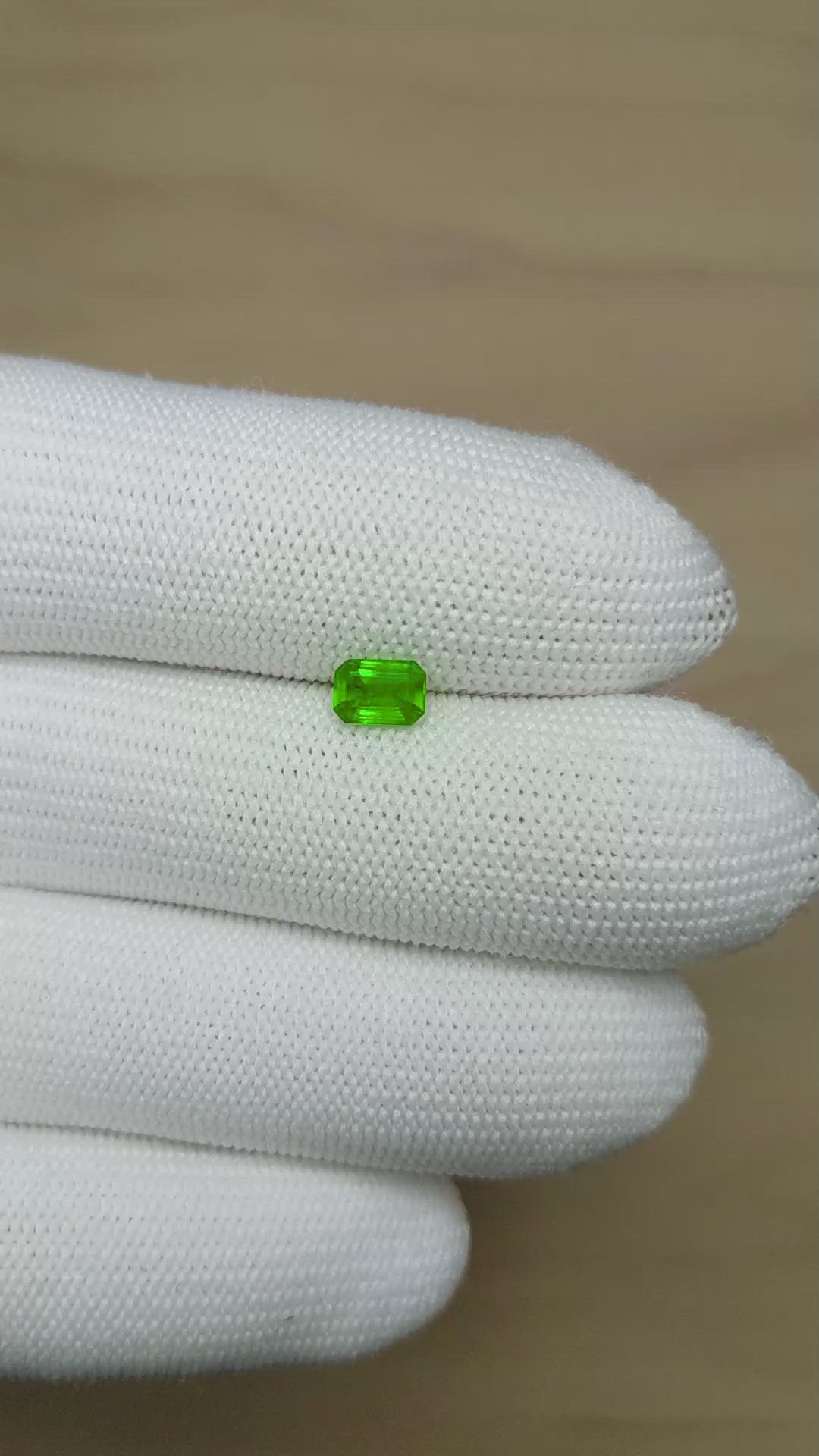
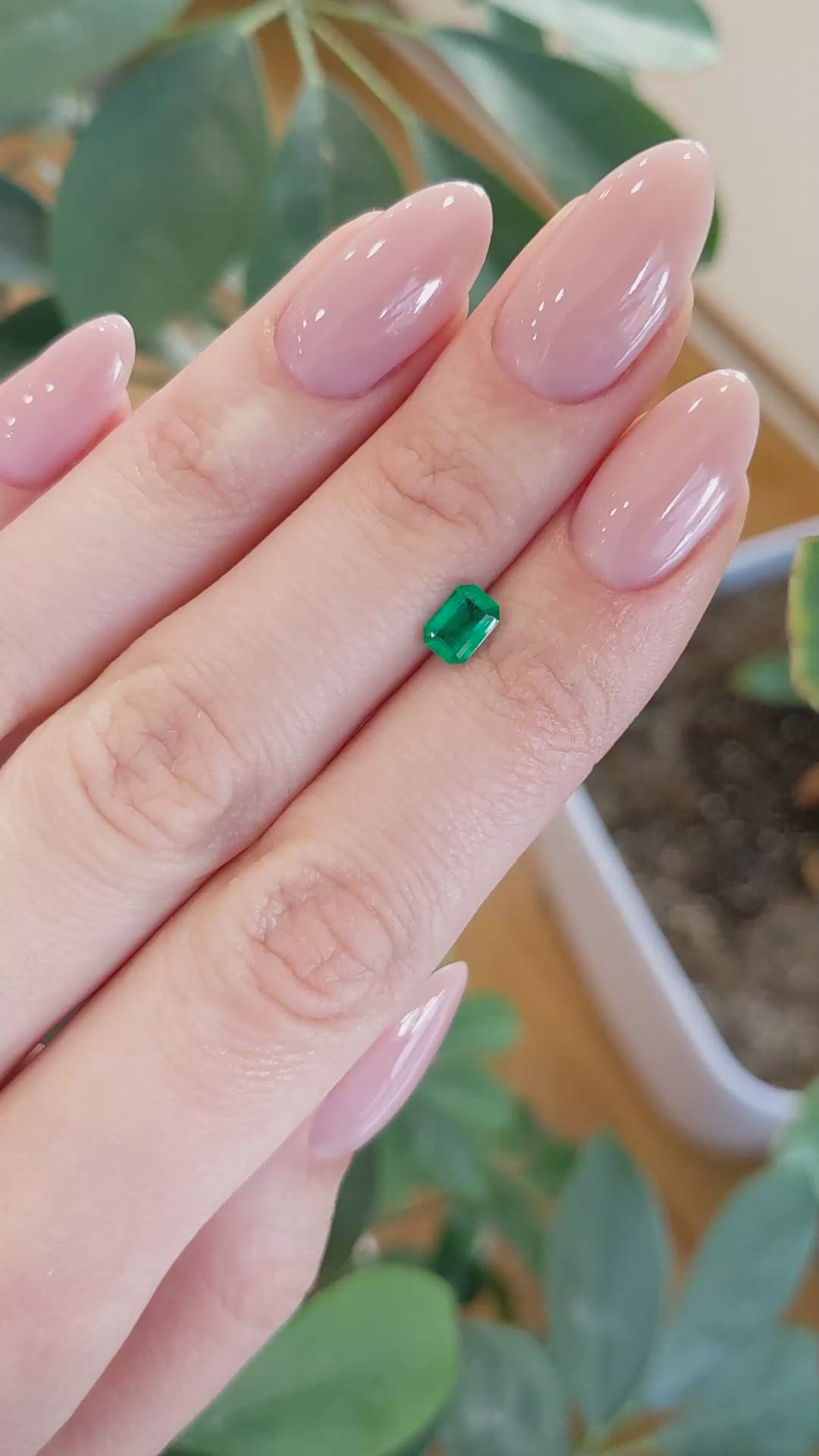

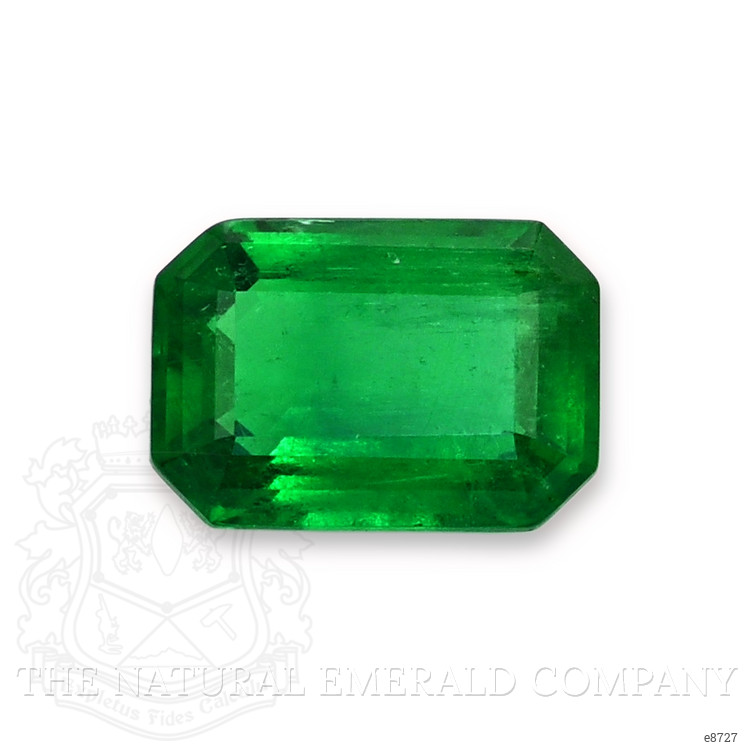
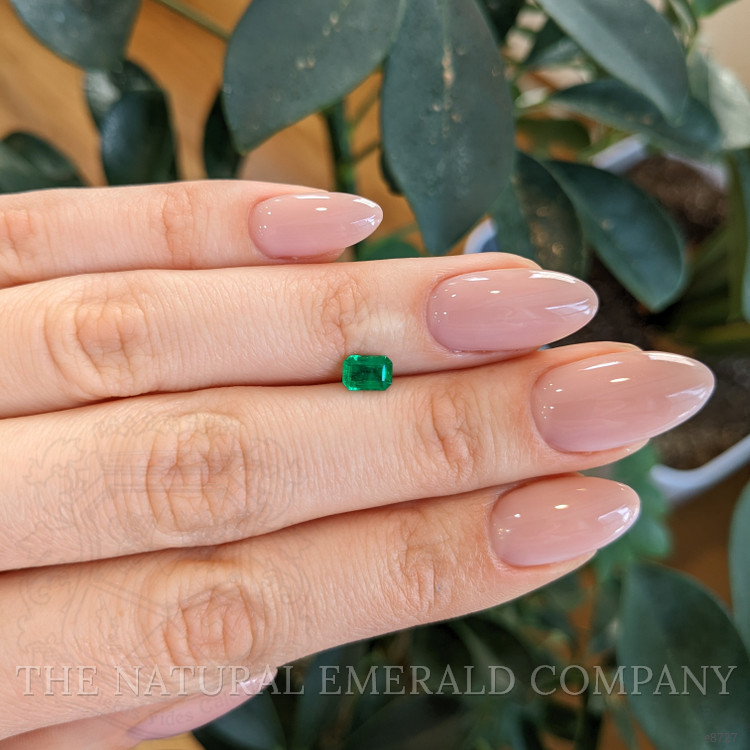
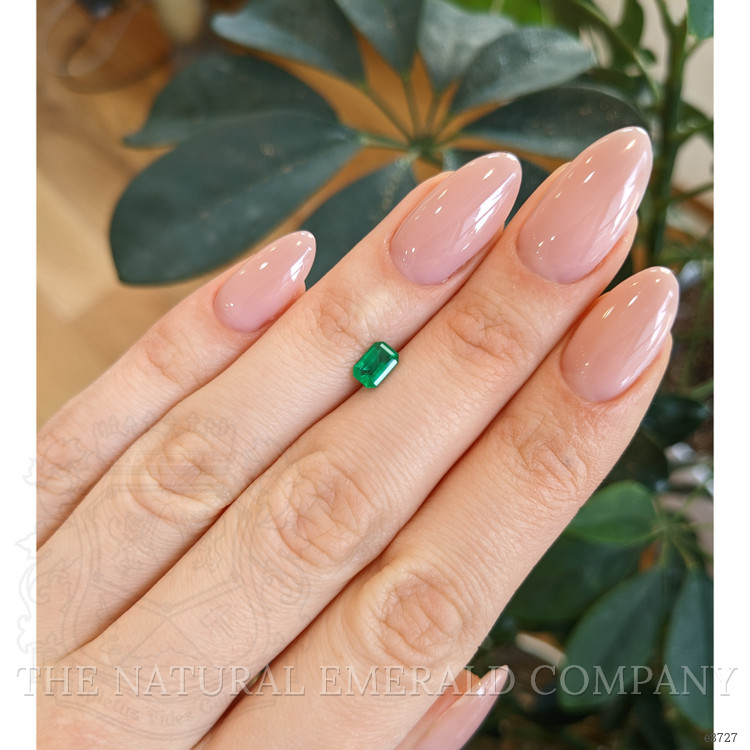

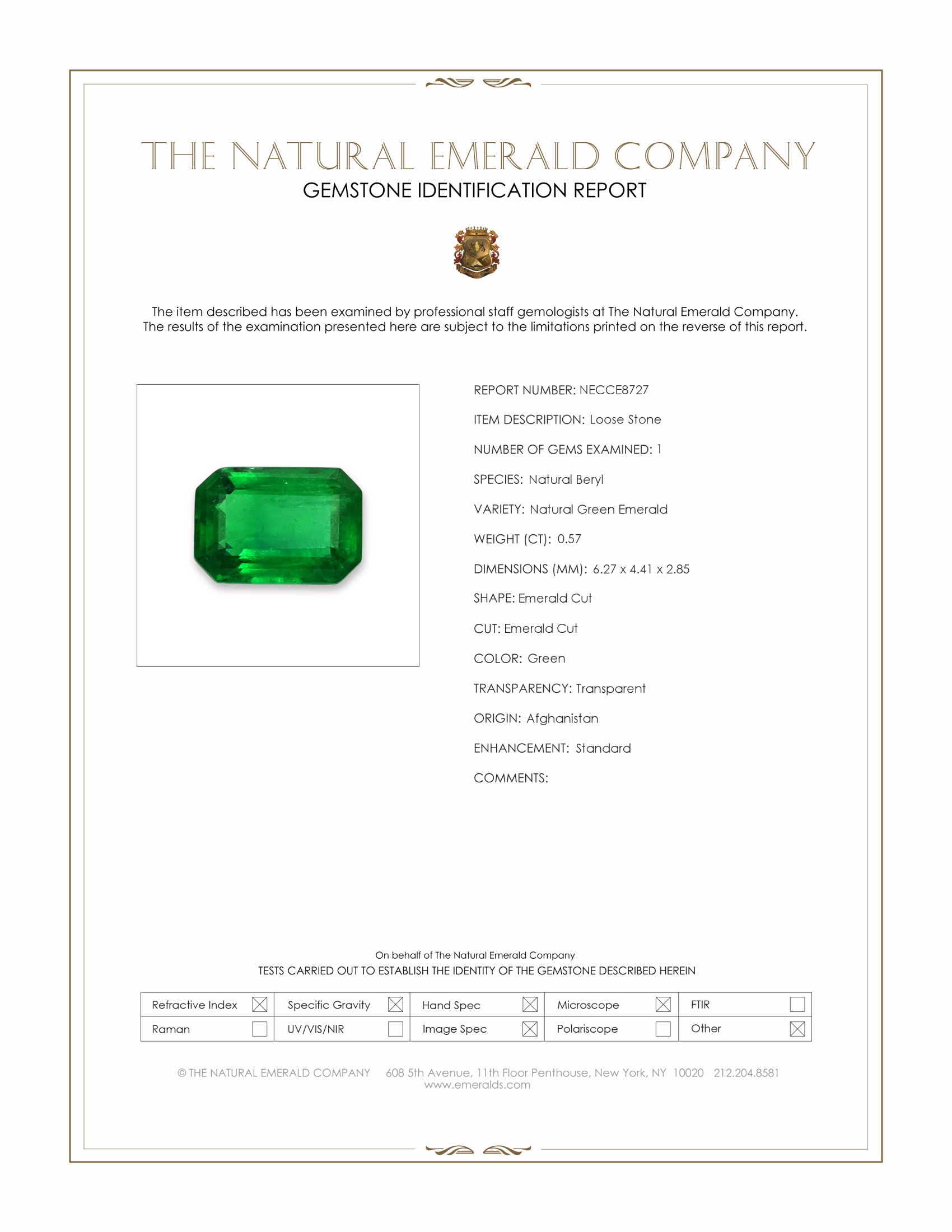
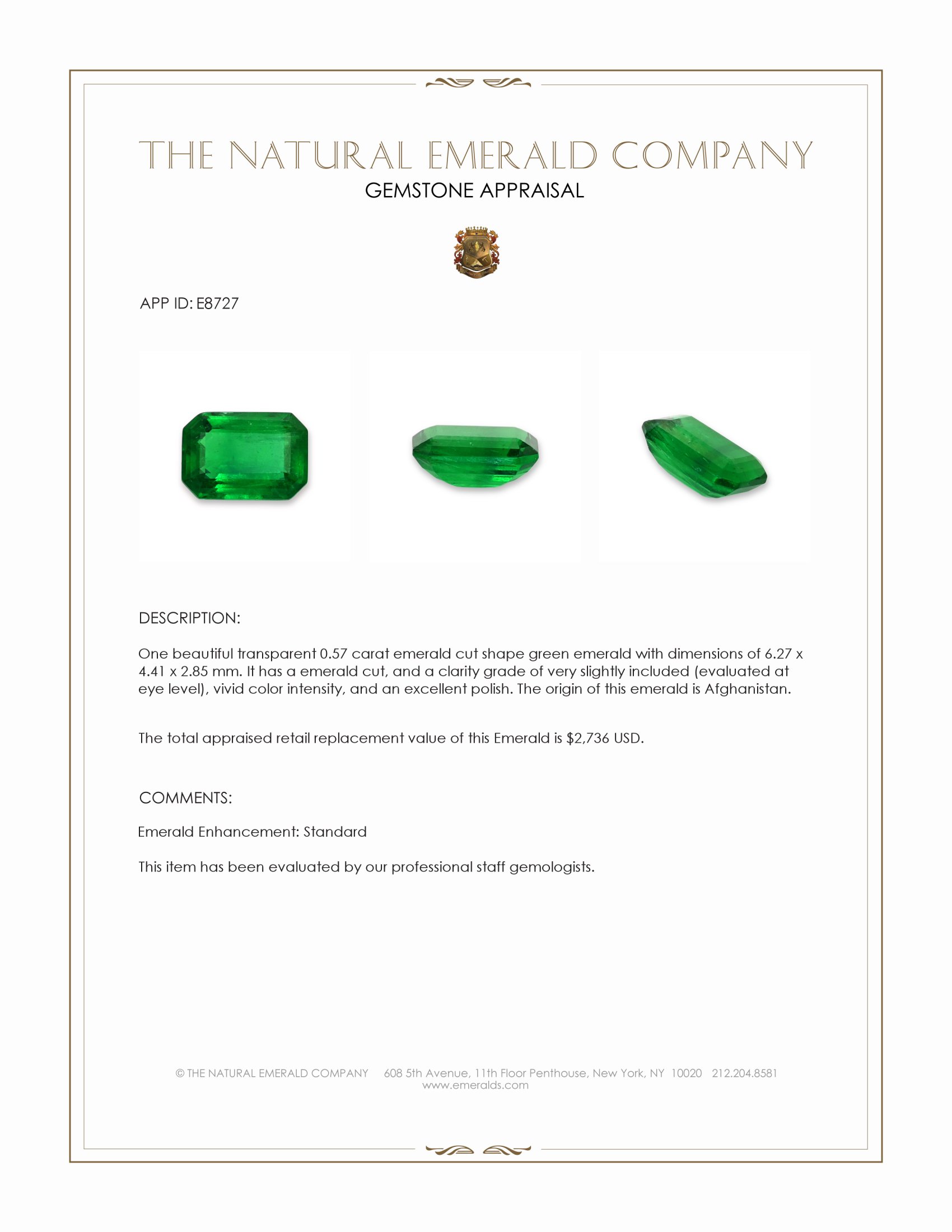
0.57 Ct. Emerald from Afghanistan
This loose stone is available to ship now
Item ID: | E8727 |
|---|---|
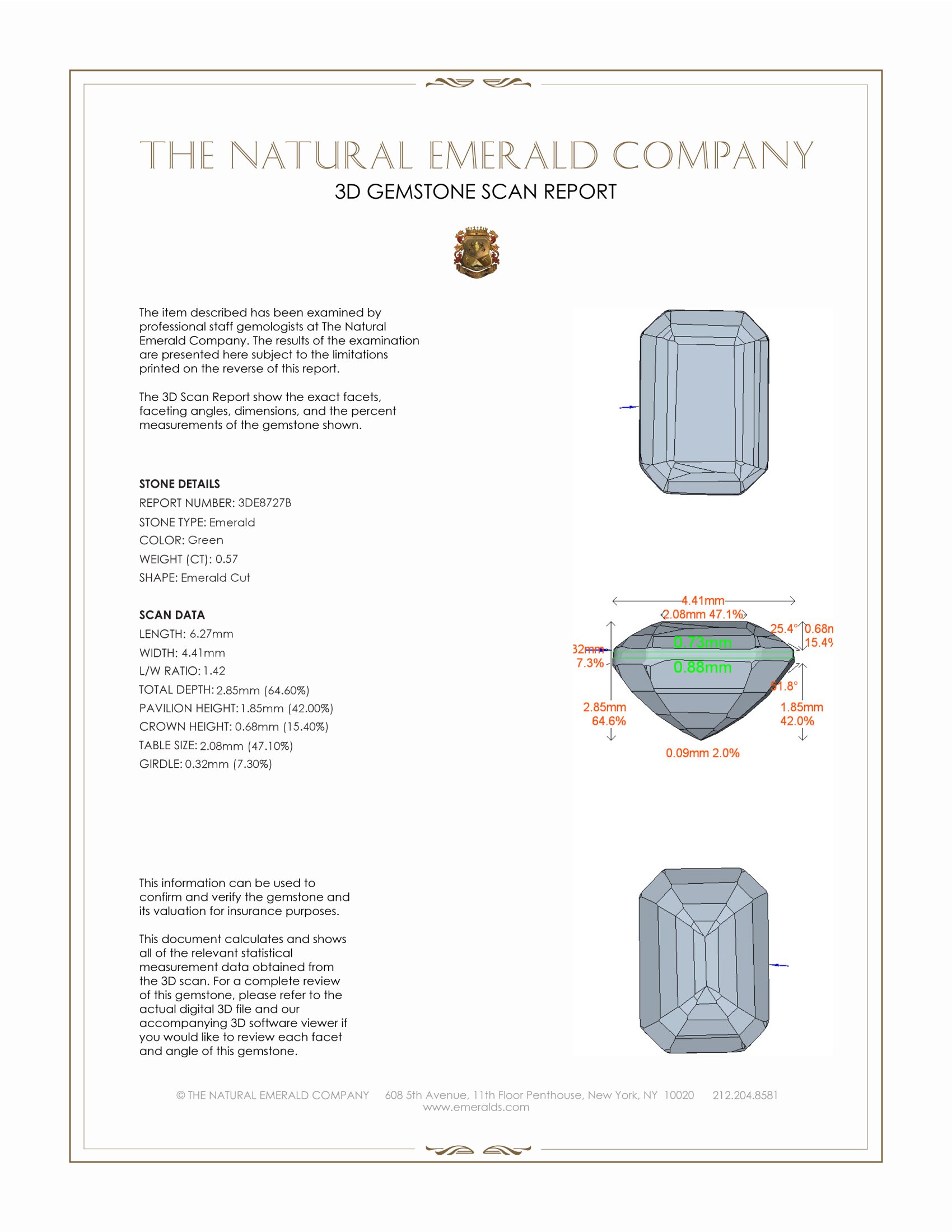
Dimensions (MM): help | Length: 6.27 Width: 4.41 Height: 2.85 |
Weight: | 0.57 Ct. |
Color: help | Green |
Color intensity: help | Vivid |
Clarity: help | Very Slightly Included |
Shape: help | Emerald Cut |
Cut: | Emerald Cut |
Cutting style: | Faceted |
Enhancements: help | Standard |
Origin: help | Afghanistan |
Per carat price: help | $4,800 |
This 0.57 carat emerald from The Natural Emerald Company is presented in a classic emerald cut, with exact dimensions of 6.27 x 4.41 x 2.85 millimeters, and a measured depth proportion of approximately 53.4 percent when calculated against the average of length and width. The stone displays vivid color intensity, a very slightly included clarity grade when evaluated at eye level, and an excellent polish. The cutting strategy employed for this piece follows traditional step facet geometry, featuring a broad rectangular table, a series of parallel crown and pavilion steps, and well defined facet junctions. The slightly elongated length to width ratio of approximately 1.42 gives the stone a balanced profile that reads as elegant on the finger, while the relatively shallow to medium depth preserves face up spread and saturation. The standard enhancement applied is consistent with industry practice for natural emeralds from Afghanistan, and the origin imparts specific trace element signatures that influence hue and saturation in ways that are observable under gemological examination.
The faceting and finishing reflect deliberate craftsmanship choices aimed at optimizing color and light performance rather than maximizing scintillation alone. In an emerald cut the primary optical objective is to maintain even color distribution and a velvety depth, therefore the cutter has used wide step facets and restrained crown angles to avoid windowing and to promote broad, even color planes. The excellent polish indicates close control of final lap progression and careful removal of polish lines at facet junctions, yielding crisp facet intersections and clean reflections. Clarity assessment of very slightly included at eye level indicates the presence of minor internal features typical of natural emeralds, such as thin healed fissures, minute crystalline inclusions, and fine growth planes, all of which contribute to the stone s characteristic jardin without materially compromising transparency. The cutting orientation was selected to position inclusions away from the table plane where possible, improving apparent clarity while preserving natural material and color.
Color plays a primary role in the appeal of this emerald, the stone exhibiting a rich, saturated green that reads as vivid in standard daylight and in photographic lighting, with minimal zoning and an even tone across the table and step facets. The green displays the depth and complexity expected from natural Afghan emeralds, where chromium and vanadium concentrations create a vivid green with a subtle cool bias that enhances visual depth. Compared to lab grown emeralds, natural stones like this present a more complex internal character and spectral fingerprint, with inclusion patterns and trace element distributions that are measurable under microscopy and spectroscopy. Lab grown emeralds can offer very uniform color and cleaner clarity, but that uniformity often results in a flatter appearance and an absence of the layered depth and internal texture that give natural emeralds their distinctive luminosity. Natural emeralds also show natural growth sector zoning and three phase inclusions that confirm geological origin, attributes that are important for collectors and connoisseurs who value provenance and authenticity.
Beyond aesthetics, there are material and market advantages to choosing this natural Afghan emerald over synthetic alternatives, particularly for buyers who value provenance, rarity, and long term collectability. Natural emeralds form over millions of years under specific geological conditions, producing unique inclusion assemblages that serve as natural identifiers, while synthetic stones are reproducible and may lack the forensic markers that certify origin. From a market perspective, high quality natural emeralds with vivid color and careful cutting typically retain or appreciate in value over time in a way that lab grown equivalents seldom match, because supply of comparable natural material is inherently limited and linked to specific localities. Practically, the standard oiling enhancement applied to this emerald is reversible and re treatable by qualified lapidaries, and it is commonly accepted in the trade as a conservation technique that improves stability and visual appeal without altering the fundamental natural origin. For setting recommendations by The Natural Emerald Company, the stone s depth and step cut suit a low to medium profile bezel or four prong setting that protects the corners and showcases the broad table, and routine care should avoid ultrasonic cleaning and harsh solvents, favoring gentle warm soapy water and soft brushes, with periodic inspection to maintain the enhancement and mounting security.


