
The Emeralds of the Mughal
Mughal emeralds are the large, often carved emeralds treasured by the Mughal emperors, who ruled much of the Indian subcontinent from 1526 to 1857. Most of the finest stones were mined in Colombia, carried across the world by Spanish and Portuguese traders, and then carved by Indian craftsmen with flowers, leaves, and sacred inscriptions, especially in the 17th century. They are prized today because they combine three rare qualities: exceptional Colombian emerald, extraordinary artistry, and royal history. The most famous surviving example, the 217.80-carat “Mogul Emerald,” is dated 1695–96.
The Mughal emperors were among history’s greatest collectors of precious gemstones. Emeralds held a particularly important place in their treasuries, alongside diamonds, rubies, spinels, and pearls.
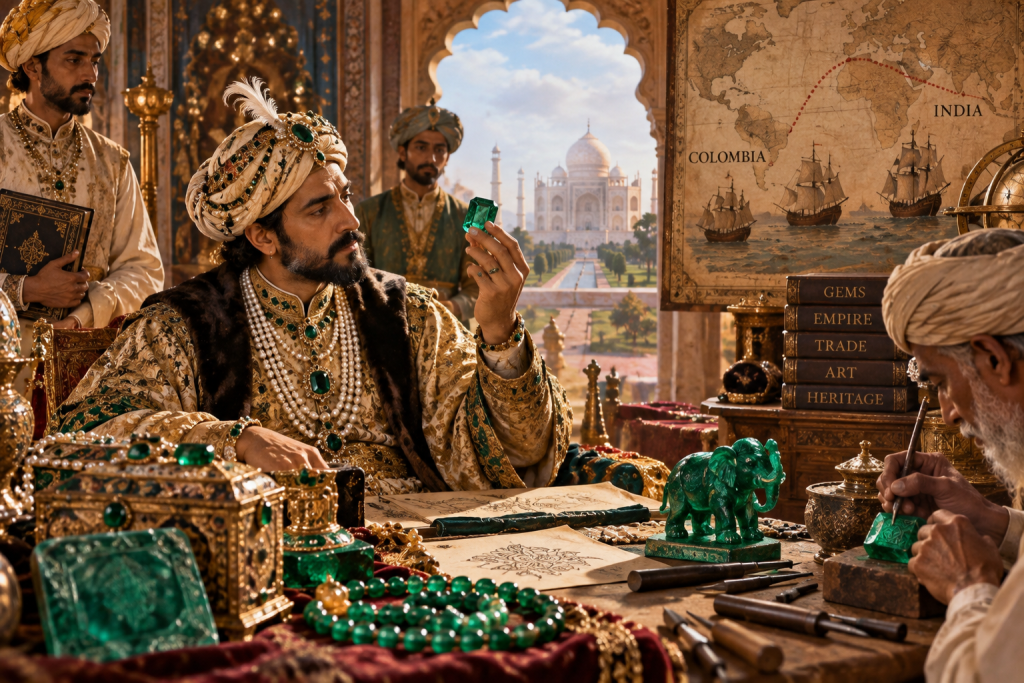
How Colombian Emeralds Reached India
Emeralds were known in India before the Mughals, but fine, large stones were scarce until Colombian material arrived. After the Spanish took control of Colombia’s emerald deposits in the 16th century, the stones entered international trade. From Spain and Portugal, merchants carried many of them to the Middle East and India. Follow that journey in our article on Colombian emeralds and the Spanish galleons.
By the height of the Mughal Empire, magnificent Colombian emeralds had found their way into one of the wealthiest royal courts on Earth. So many large stones flowed east that relatively few of the biggest Colombian emeralds of the period remained in Europe.
Why the Mughals Loved Emeralds
The Mughal emperors loved gemstones of every kind, but emeralds had special meaning.
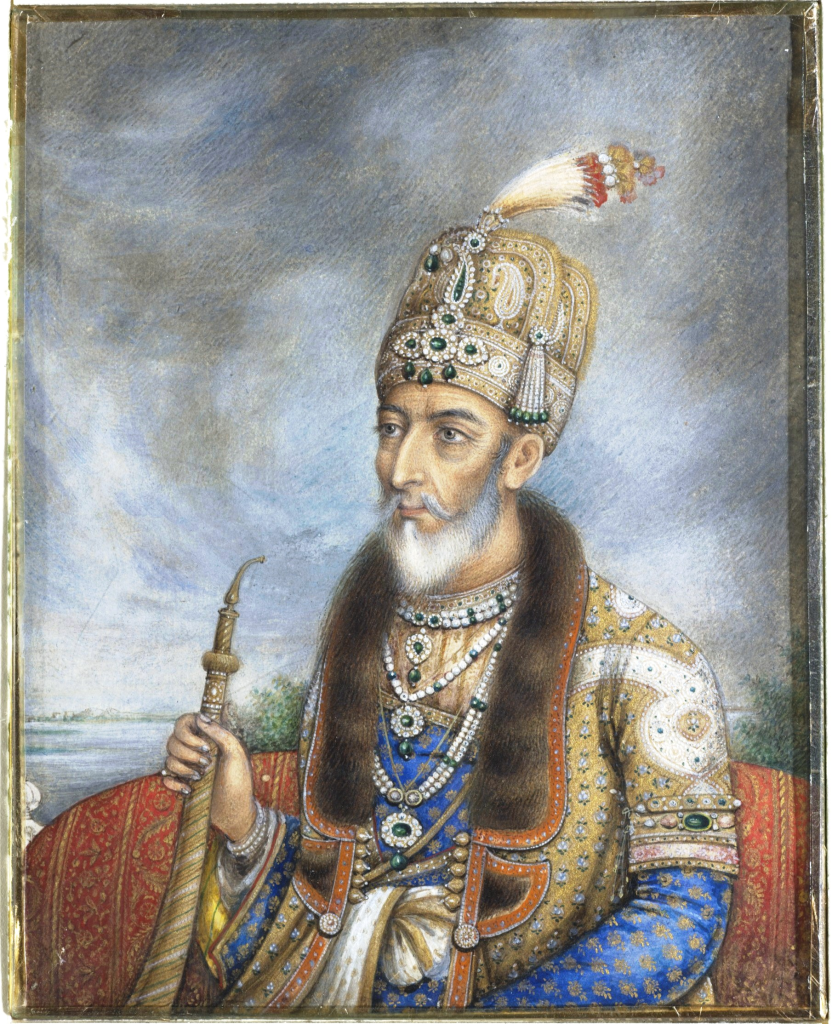
Their intense green was admired for its beauty and associated with nature, gardens, paradise, and prosperity. Green also holds deep significance in Islamic culture as the color associated with paradise. Large emeralds were ideal for royal jewelry, ceremonial treasures, and personal talismans, and some carried Qur’anic verses or prayers, which suggests they were also valued for protective, spiritual meaning.
The Art of Carved Mughal Emeralds
Rather than faceting every emerald for maximum brilliance, Mughal craftsmen often treated the gem as a surface for art. Large stones were carved with delicate flowers, leaves, geometric patterns, calligraphy, and religious inscriptions.
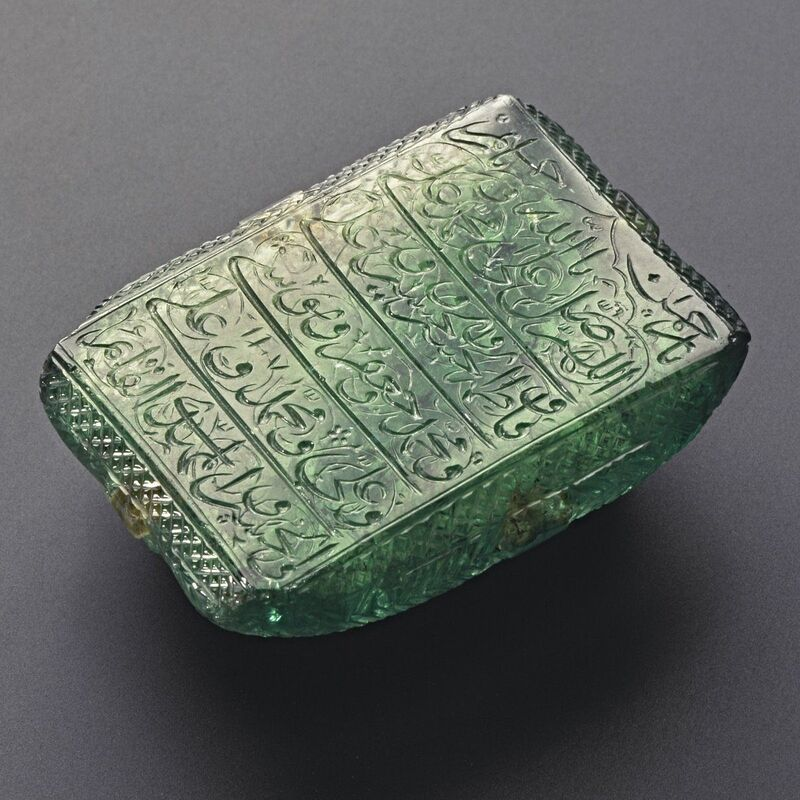
Carving suited emerald well. Many rough emerald crystals have flat, tablet-like shapes and natural inclusions, and shallow carving let artisans keep as much weight and color as possible while creating something unique.
Floral designs were especially fitting. Mughal architecture, textiles, gardens, and decorative arts celebrated nature, and the same artistic language appeared on gemstones, turning an already rare emerald into a one-of-a-kind work of art.
Emeralds in the Court of Shah Jahan
Gemstone craftsmanship reached extraordinary levels during the reign of Shah Jahan, who ruled from 1628 to 1658.
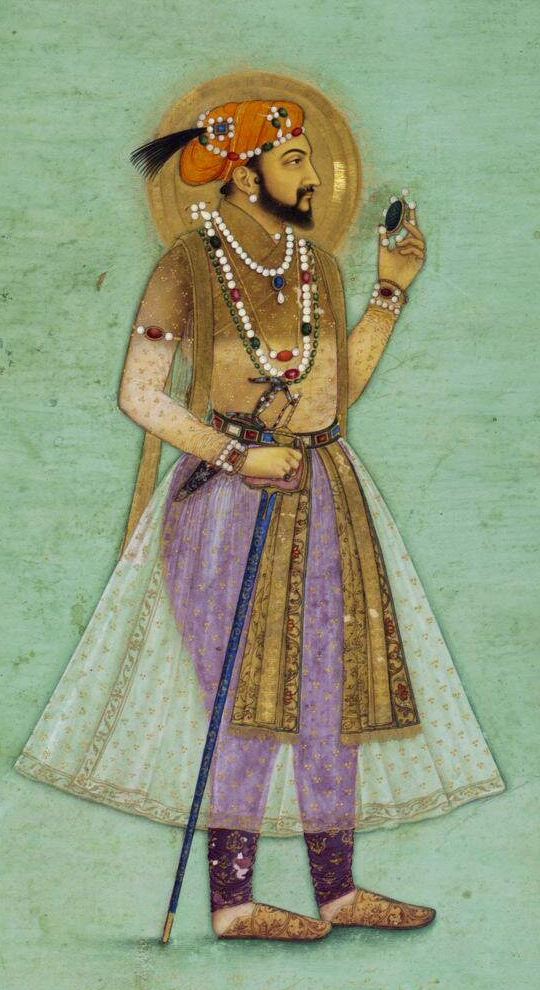
Best known for commissioning the Taj Mahal, Shah Jahan presided over a court celebrated for architecture, jewelry, and decorative arts. Precious stones appeared in royal ornaments, turban jewels, weapons, ceremonial objects, and luxurious furnishings.
.

The flowing floral style of this period, seen in the inlaid flowers of the Taj Mahal itself, was beautifully suited to carved emeralds.
The Famous Mughal Emerald
The best-known surviving example of this tradition is the “Mogul Mughal” emerald, a carved Colombian emerald weighing 217.80 carats.
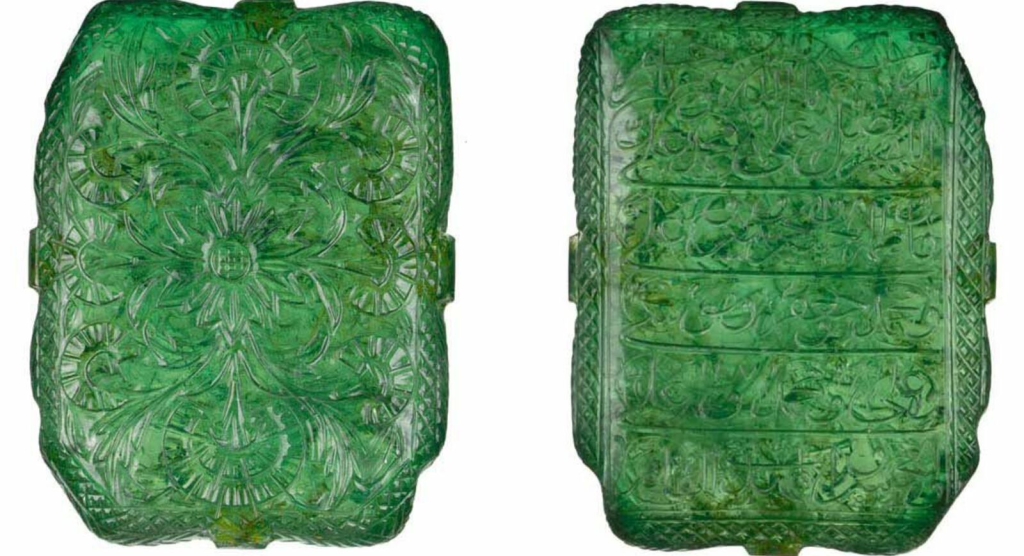
One side is engraved with a Shi’a prayer in elegant script and the date 1107 AH, which corresponds to 1695–96 CE, during the reign of Emperor Aurangzeb. The reverse is carved with a central rosette and poppy flowers. It is one of very few dated Mughal emeralds, which is why specialists use it as a benchmark for dating other carved Indian emeralds.
Although it is called the Mogul Emerald, its exact owner is unknown. Because the Mughal emperors were Sunni Muslims and the prayer is Shi’a, experts believe it more likely belonged to a member of the court than to Aurangzeb himself. The emerald was sold at Christie’s in London in 2001 and is now in the collection of the Museum of Islamic Art in Doha, Qatar. Discover other record-setting stones in the world’s most expensive emeralds ever sold.
More Than Jewelry
Mughal emeralds were not limited to rings and necklaces. They decorated turban ornaments, armbands, pendants, ceremonial weapons, boxes, and other royal objects. Large gems were also kept as individual treasures because of their rarity and beauty.
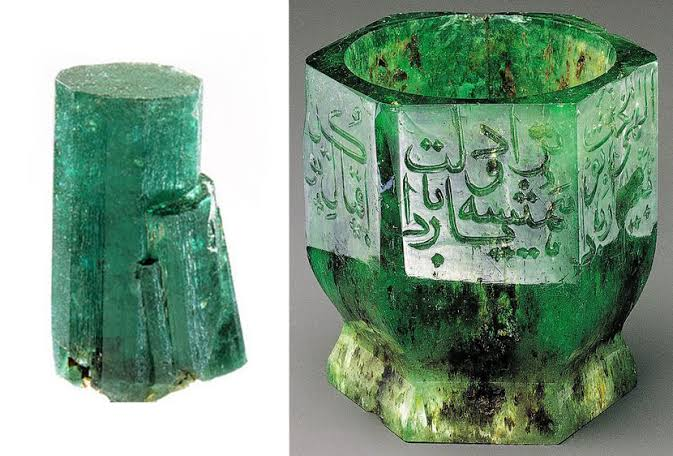
For an emperor, possessing extraordinary gemstones was a visible demonstration of wealth and authority.
What Happened to the Mughal Emerald Treasures?
Many Mughal treasures were dispersed as the empire weakened. When the Persian ruler Nader Shah sacked Delhi in 1739, he carried away vast quantities of jewels, and at least one known inscribed emerald bears his name.
War, invasion, political change, inheritance, and the growth of European colonial power moved gems and jeweled objects into new royal and private collections. Some were dismantled and their stones reused; others disappeared completely.
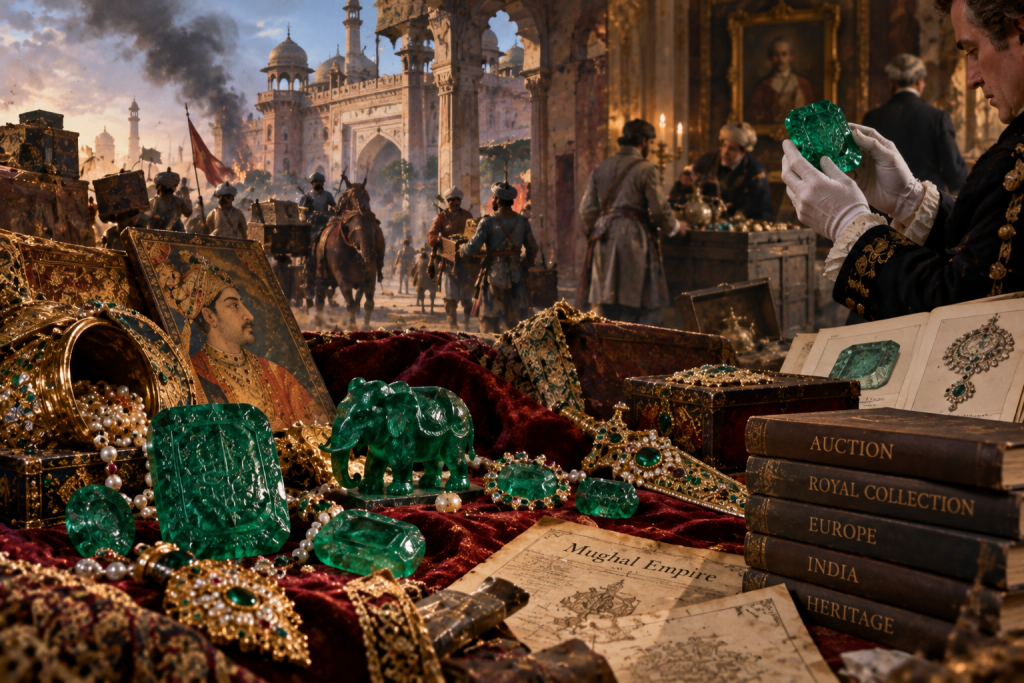
As a result, surviving carved Mughal emeralds are especially important historical objects, because they preserve a form of craftsmanship that might otherwise have been lost.
Why Mughal Emeralds Still Fascinate Collectors
Historic Mughal emeralds combine the qualities that make gemstones most compelling: rarity, craftsmanship, provenance, and cultural history.
A fine emerald is already a remarkable natural creation. When it also carries a centuries-old carving or inscription, its importance reaches beyond color, clarity, cut, and carat weight. It becomes a piece of history. Emerald’s royal story goes back much further, too. See why Cleopatra was fascinated by emeralds.
Final Thoughts
The emeralds of the Mughal Empire tell an extraordinary story of early global trade and artistic achievement. Mined in Colombia, carried across oceans, and carved by skilled craftsmen in India, these gemstones connected distant parts of the world centuries ago.
Their floral carvings, inscriptions, and royal associations show that the Mughals saw gemstones as far more than symbols of wealth. They were objects of beauty, faith, craftsmanship, and power. If you would like to find a remarkable emerald of your own, start with our Emerald Buying Guide.
Explore our finest natural emeralds and find a remarkable green treasure to make part of your
own story.